
A normal renovation deposit in Malaysia is 10–25% of the total project value. Anything above 30% is unusual. A 50% deposit upfront is a red flag.
The deposit covers the contractor's upfront material purchases and mobilisation. Beyond that, payment should track actual progress — you pay more as more work is completed, not before it starts. A contractor asking for half the project value before lifting a finger has an incentive structure that doesn't protect you.
The deposit percentage alone isn't the full picture. What matters just as much is whether there's a written payment schedule tied to measurable milestones — not vague ones like "when progress is made." More on this below.
What Does a Fair Payment Structure Look Like?
Most homeowners focus only on the deposit percentage, but the full payment schedule is what actually protects you. Here's the structure that the industry uses.
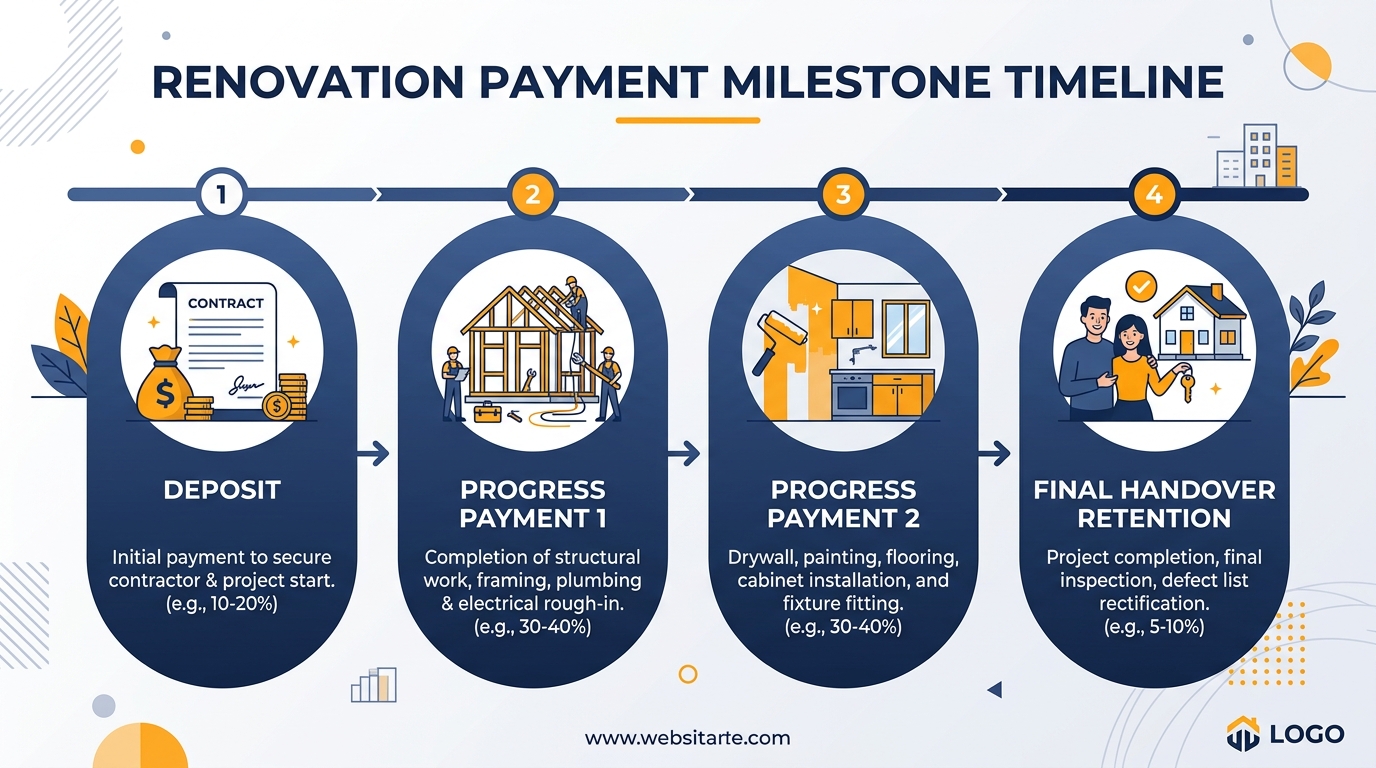
This is what a well-structured renovation contract looks like for a RM60,000 project.
Payment structures that should make you pause — or walk away.
What a High Deposit Request Actually Signals
A contractor asking for 50% upfront isn't always a scammer. But it's almost always a problem.
Legitimate reasons do exist. If you've specified long lead-time materials — imported tiles, custom-made cabinetry, structural steel — a contractor may need upfront cash to lock in those orders. But here's the thing: that should be documented. The contract should state exactly which materials the deposit covers, with supplier names or item specs. A blanket "50% to start work" with no justification is different.
More often, a high deposit signals one of these:
| Reason | What It Means for You | Status |
|---|---|---|
| Funding another client's project | Your money is subsidising someone else's job. Delays follow when that project overruns. | Red flag |
| Cash flow problems | Contractor can't float materials from existing capital. Risk of stopping mid-project. | Red flag |
| Covering business operating costs | Your deposit pays salaries, rent, or previous debts — not your project. | Red flag |
| Legitimate long lead-time materials | Specific and documented. Contractor shows what the deposit covers. | Acceptable |
| "That's just how we do it" | No justification given. Won't negotiate. Pressure to pay fast. | Walk away |
Renovation deposits are one of the most common mechanisms in contractor scams. A contractor collects a large deposit from multiple homeowners, starts none of the jobs (or starts briefly and stalls), and eventually becomes unreachable. Read our guide on renovation scams in Malaysia to see the full pattern — the deposit angle is only one part of it.
How to Push Back When Asked for Too Much
Most homeowners accept whatever payment structure the contractor proposes because they don't know there's a norm to reference. Now you do.
If your contractor asks for more than 25–30% upfront, here's how to respond:
"I'm comfortable with the standard industry structure — 20% deposit, then milestone-based payments at 50% and 80% completion, with 10% retention on handover. Can we structure the contract that way?"
A legitimate contractor will usually agree, or propose a slight variation with a clear reason. What you should watch for is a contractor who:
- Refuses to negotiate at all
- Gets defensive or impatient when asked for justification
- Offers to "give a discount" contingent on paying the full deposit immediately
- Can't name what specific materials the deposit is for
These aren't negotiation tactics — they're exits. If a contractor won't agree to a payment schedule that protects you, they are telling you something about how the project will go.
The Sample Payment Schedule You Can Use
Here's a template you can reference — or paste into your own contract negotiation — for a typical residential renovation in Malaysia.
Stage 1 — Deposit: RM12,000 (20%) — payable upon signing of contract
Stage 2 — Progress 1: RM21,000 (35%) — payable when demolition complete + structural works at 50%
Stage 3 — Progress 2: RM21,000 (35%) — payable when flooring, cabinets, and fixtures installed
Stage 4 — Retention: RM6,000 (10%) — payable 3 months after handover, pending defect clearance
Total: RM60,000 (100%)
Adjust the percentages to your project. The principle stays the same: the contractor should always have more to gain by completing work than by stopping. That's what a well-structured payment schedule does.
A fair deposit structure is only part of the picture. The bigger risk is often hidden in the quotation itself — line items priced 30–50% above market, vague scope descriptions that enable cost blowouts, or variation orders (VOs) used to inflate the final bill. Once you've agreed on the payment schedule, use this guide to check if your renovation quote is fair before you sign anything.
What Gets Written Into the Contract
Even the best verbal agreement means nothing if it's not in the contract. Before paying any deposit, make sure the signed document states:
| Clause | What to Look For | Status if Missing |
|---|---|---|
| Deposit amount + % | Exact RM figure and percentage of total | Do not pay |
| Payment milestones | Measurable triggers (not "when progress is made") | Negotiate first |
| Retention clause | % withheld and duration (e.g. 10% for 3 months) | Ask for it |
| Non-refundability terms | When the deposit is forfeit vs refundable | Clarify verbally |
| Total contract value | Fixed sum, or clearly stated + VO conditions | Do not sign |
- Contractor abandons project: Document everything (photos, messages), then file with CIDB (Construction Industry Development Board) and KPDN
- Contractor refuses to return: Send a formal letter via lawyer — a RM200–400 letter of demand is often enough to restart communication
- Deposit paid in cash with no receipt: Very difficult to recover — avoid cash payments above RM500 without a proper receipt and contract
Your quote has payment terms too — are they fair?
Upload your contractor's quotation at RenovIQ. The AI reads the payment structure, flags abnormal deposit percentages, and checks if the line-item prices are in range.
Check My Quote — FreeFrequently Asked Questions
The standard renovation deposit in Malaysia is 10–25% of the total project value. For a RM60,000 project, that's RM6,000–RM15,000. Anything above 30% should be questioned; 50% upfront is a red flag regardless of the explanation given.
No. A 50% deposit is not industry standard in Malaysia. Legitimate contractors do not need half the project value before work begins. If a contractor insists on 50% upfront and won't negotiate, treat it as a warning sign — not just of overcharging, but of potential project abandonment.
A fair renovation payment schedule: 10–25% deposit on signing, 30–40% at roughly 50% completion, 25–35% at 80–90% completion, and 10% retention held for 3–6 months after handover. The total adds up to 100% and the contractor always has money left to earn — which means they have a reason to finish.
A legitimate contractor will usually negotiate. Propose the industry-standard structure in writing. If they refuse to budge below 40–50% and become aggressive when questioned, that's a red flag in itself. You're not obligated to sign — and the cost of walking away from a bad contractor is always lower than the cost of a failed project.
Deposits are generally non-refundable under most renovation agreements. Recovery depends on whether you have a signed contract. Options: file with CIDB, pursue civil action, or lodge a report with KPDN. This is exactly why limiting the deposit matters — the less you've paid before work starts, the less you lose if things go wrong.
Yes, always. The deposit amount, payment milestones, and conditions for each milestone must be in writing before any money changes hands. If your contractor only has a verbal agreement for the deposit, don't pay until you have a signed document. A contractor who won't put it in writing is telling you something.
Sometimes it's legitimate — upfront material purchases for custom or imported items. But these should be itemised and documented. More often, a high deposit request signals cash flow problems, funding other projects with your money, or covering operating expenses. If a contractor can't explain specifically what the deposit covers, that's a problem.